Help employees communicate clearly, confidently and professionally in English across every workplace situation. Use this ready-to-customize training template to cover plain English, tone and register, email and report writing, meetings, presentations, phone and video calls, negotiation, difficult conversations and cross-cultural communication.
In many organizations, English is the shared working language between colleagues, customers and partners from different countries and backgrounds. Even highly skilled employees can lose impact when emails are unclear, meetings feel uncomfortable, presentations lack structure or the tone of a message is misread. Most people need practical language, simple structures and plenty of real workplace examples rather than grammar theory alone.
This template provides a practical foundation in business English and professional communication. It covers clear and concise writing, tone and register, professional emails, reports and proposals, participating in and leading meetings, virtual communication, presentations, telephone and customer conversations, negotiation and persuasion, handling difficult conversations, and communicating effectively across cultures.
A suggested eight-module structure that can be adapted to your learners' English level, job roles, industry, customer base and internal communication standards.
Introduce the principles of clear professional communication: knowing your purpose and audience, choosing the right level of formality, using plain English instead of complicated phrasing and structuring messages so the main point comes first. Cover common mistakes that make messages unclear, overly direct or too indirect, with practical before-and-after examples.
Help learners write emails and workplace messages that are clear, polite and action-focused. Cover subject lines, openings and closings, structuring requests, giving updates, following up, replying to complaints, and adapting tone for colleagues, managers, clients and suppliers, including when a call or meeting may be better than a written message.
Build skills for writing longer business documents with a clear structure and purpose. Cover summaries, reports, proposals, meeting minutes and internal updates, with guidance on headings, concise paragraphs, presenting data in words, proofreading and making a clear recommendation or next step.
Give learners useful language and confidence to participate fully in meetings: giving opinions, agreeing and disagreeing politely, asking for clarification, interrupting appropriately and summarizing actions. Cover chairing simple meetings and the specific challenges of video calls, such as audio issues, turn-taking and keeping remote participants engaged.
Teach learners to plan and deliver short business presentations with a clear structure, signposting language, simple visuals and a confident close. Cover pace, pronunciation for clarity, body language, handling nerves and responding to questions, including what to say when you do not know the answer.
Build practical skills for professional calls and customer interactions: greeting, identifying the caller's need, asking questions, confirming details, managing hold and transfers, taking messages and closing politely. Include strategies for handling accents, background noise and moments when learners do not understand.
Help learners use diplomatic language to persuade, negotiate and handle sensitive situations. Cover making proposals, softening disagreement, saying no politely, managing complaints, giving and receiving feedback and staying calm and professional when conversations become challenging.
Bring the course together by exploring how culture influences directness, formality, time, hierarchy and relationship-building in communication. Cover how to avoid misunderstandings, adapt to different communication styles, use inclusive language and apply your organization's communication standards across email, meetings and customer interactions.
Give employees practical language, clear structures and real workplace practice so they can communicate with confidence and impact in English.
Help employees structure messages around purpose and audience so emails, updates and conversations are easier to understand and act on.
Give learners ready-to-use language and techniques so they contribute ideas, ask questions and present with greater confidence.
Improve the tone, clarity and professionalism of every customer interaction, from first email to complaint resolution.
Help multicultural and international teams understand different communication styles and reduce friction caused by tone or cultural assumptions.
Reduce time lost to unclear messages, back-and-forth emails and repeated explanations, while presenting a consistent, professional image of your organization.

By the end of the training, learners should be able to:
Use one core business English template, then emphasize the communication situations, language and level of responsibility each audience is likely to encounter.
| Audience | What to emphasize |
|---|---|
| Customer-facing / service staff | Telephone and chat language, greeting and closing, asking clarifying questions, handling complaints, apologizing and offering solutions, tone consistency and customer emails. |
| Managers / team leads | Leading meetings, giving instructions and feedback, delegating, performance conversations, motivating teams, writing updates and communicating change. |
| Sales & business development teams | Professional introductions, presenting products, persuasive language, negotiation, handling objections, proposal writing and building client relationships. |
| Administrative & support staff | Email and message writing, scheduling and coordination, taking messages, meeting minutes, formal letters, polite requests and internal communication. |
| Technical & specialist professionals | Explaining complex topics simply, writing reports and documentation, presenting data, communicating with non-specialists and participating in project meetings. |
Start with the core business English structure, then replace generic examples with your industry vocabulary, communication standards, customer scenarios and real workplace documents.

Add your organization's tone of voice, email and document templates, customer service standards, industry terminology and the English level or proficiency targets for each learner group.
Use approved examples based on situations employees actually face - for example client complaints, project updates, supplier negotiations, team meetings, sales calls or management reports.
Create short assessments and practice tasks around tone and register, email structure, meeting language, presentation structure, polite disagreement and cross-cultural scenarios.
Prepare an instructor-led version for language workshops, onboarding programmes, customer service training or leadership development sessions.
Let learners practise writing and ask questions based on the approved training content and communication standards you provide. The AI Coach can support practice and reinforcement, but it should not replace feedback from a qualified language trainer or formal language assessment where proficiency needs to be certified.
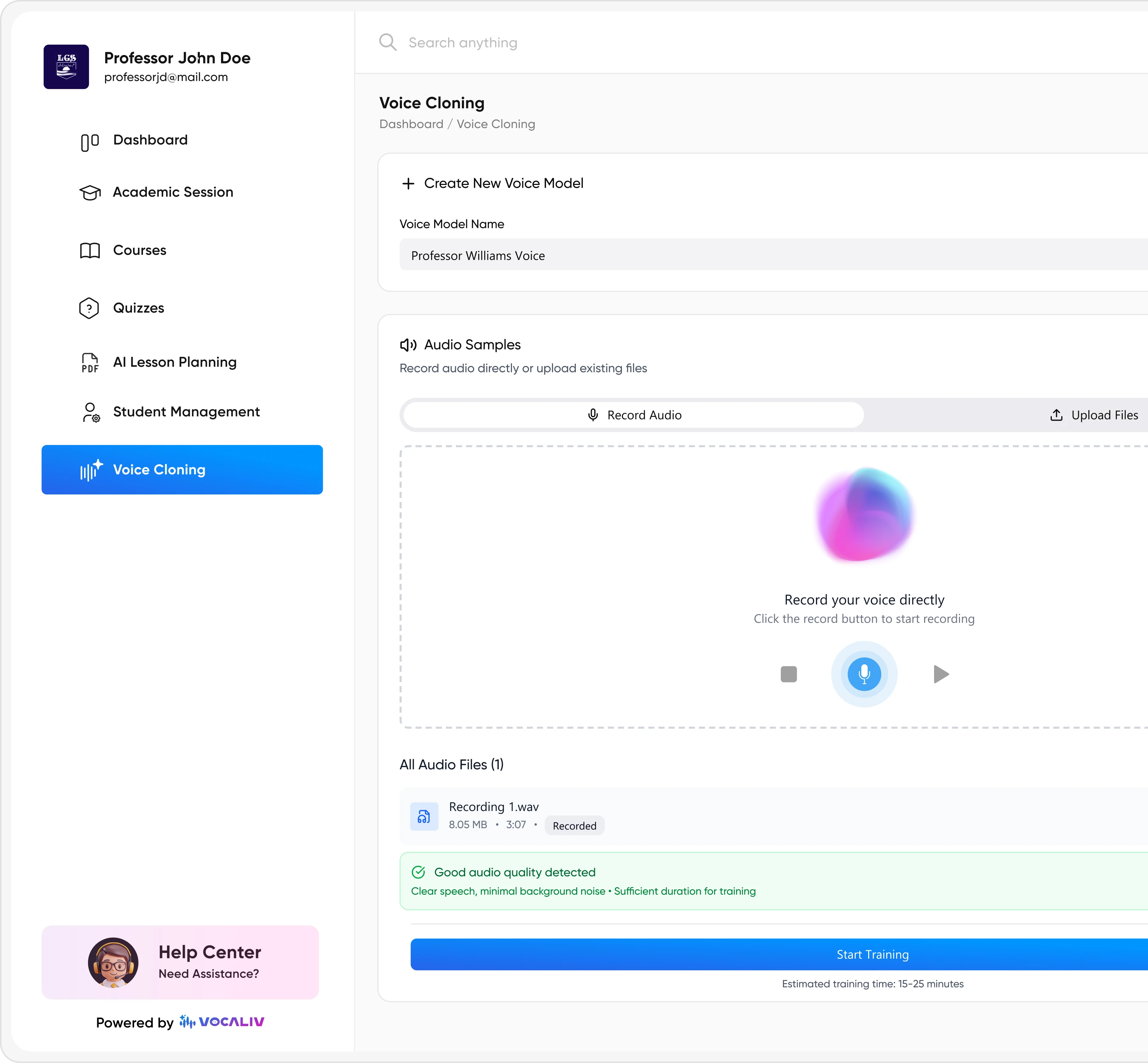
Where appropriate, voice cloning can help deliver AI-assisted course content in a familiar language trainer, communication coach or training facilitator voice.
Start with a structured business English training template, add your own communication standards, industry vocabulary and real workplace scenarios, and give employees a practical framework for writing clearly, speaking confidently and building stronger professional relationships.