A ready-to-customize course that gives customer-facing, operations and compliance teams a practical grounding in anti-money laundering (AML) and Know Your Customer (KYC). Adapt it to your own policies and risk model in Vocaliv.
AML controls only work when the people opening accounts and handling transactions know what customer information matters, how risk changes the level of due diligence and when to escalate.
This template gives you that baseline: eight structured modules, ready to tailor to your regulators, terminology and internal reporting steps.
A suggested eight-module structure that can be shortened, expanded or adapted by role.
Introduce money laundering, why organizations need AML controls and how employees contribute to preventing the misuse of products, services and customer relationships.
Explain the purpose of knowing the customer, collecting appropriate identification information and verifying identity using reliable sources and approved processes.
Show how customer, product, channel, geography and transaction factors can influence risk. Introduce standard, simplified or enhanced measures only where they are permitted by the organization's rules and applicable law.
Help learners understand why organizations look beyond the named account holder to identify the people who ultimately own or control a legal entity, and why ownership structures can affect risk.
Introduce situations that may require additional scrutiny, such as complex ownership, unusual source-of-funds information, higher-risk geographies, politically exposed persons or other risk factors defined by the organization.
Use practical examples to help learners recognize activity that may be inconsistent with a customer's expected profile, business purpose or normal transaction pattern.
Clarify the employee's role in documenting and escalating concerns through approved internal channels. Reinforce confidentiality and the need to avoid alerting customers to internal reviews or reports.
Reinforce that KYC is not always a one-time event. Cover keeping customer information current when required, documenting decisions, following record-retention rules and completing role-specific compliance responsibilities.
Turn compliance requirements into clear, role-relevant actions employees can recognize and follow.
Give employees a shared understanding of AML/KYC terminology, customer due diligence and the role of risk in compliance decisions.
Build confidence in identifying unusual customer information, behavior or transaction patterns that should be reviewed.
Connect what teams learn about a customer at onboarding with the need to notice meaningful changes over the relationship.
Make it clear that employees should follow approved internal reporting routes and protect the confidentiality of reviews and reports.
Show why accurate records, rationale and evidence matter when customer risk decisions are reviewed later.

By the end of the training, learners should be able to:
Use one core template, then emphasize the decisions each audience actually makes.
| Audience | What to emphasize |
|---|---|
| Customer onboarding / KYC teams | Identity verification, documentation quality, beneficial ownership, customer risk factors and escalation of inconsistencies. |
| Operations / payments teams | Expected activity, transaction red flags, monitoring alerts, documentation and escalation. |
| Relationship / sales teams | Customer information quality, unusual explanations or behavior, avoiding workarounds and knowing when to involve compliance. |
| Managers | Oversight, escalation culture, evidence quality, role accountability and support for risk-based decisions. |
| Compliance teams | Use the template as a baseline, then add jurisdiction-specific rules, typologies, internal thresholds and detailed procedures. |
Start with the structure, then adapt the course to your policies, learners and risk environment.

Replace generic examples with your internal KYC workflow, risk categories, escalation routes, policies and approved terminology.
Use existing compliance documents and internal guidance as inputs when building or refining the course.
Create short assessments around red flags, customer due diligence and escalation scenarios to reinforce understanding.
Prepare a facilitator-led version for onboarding sessions, workshops or refresher training.
Let learners interact with course content and ask questions based on the training material you provide.
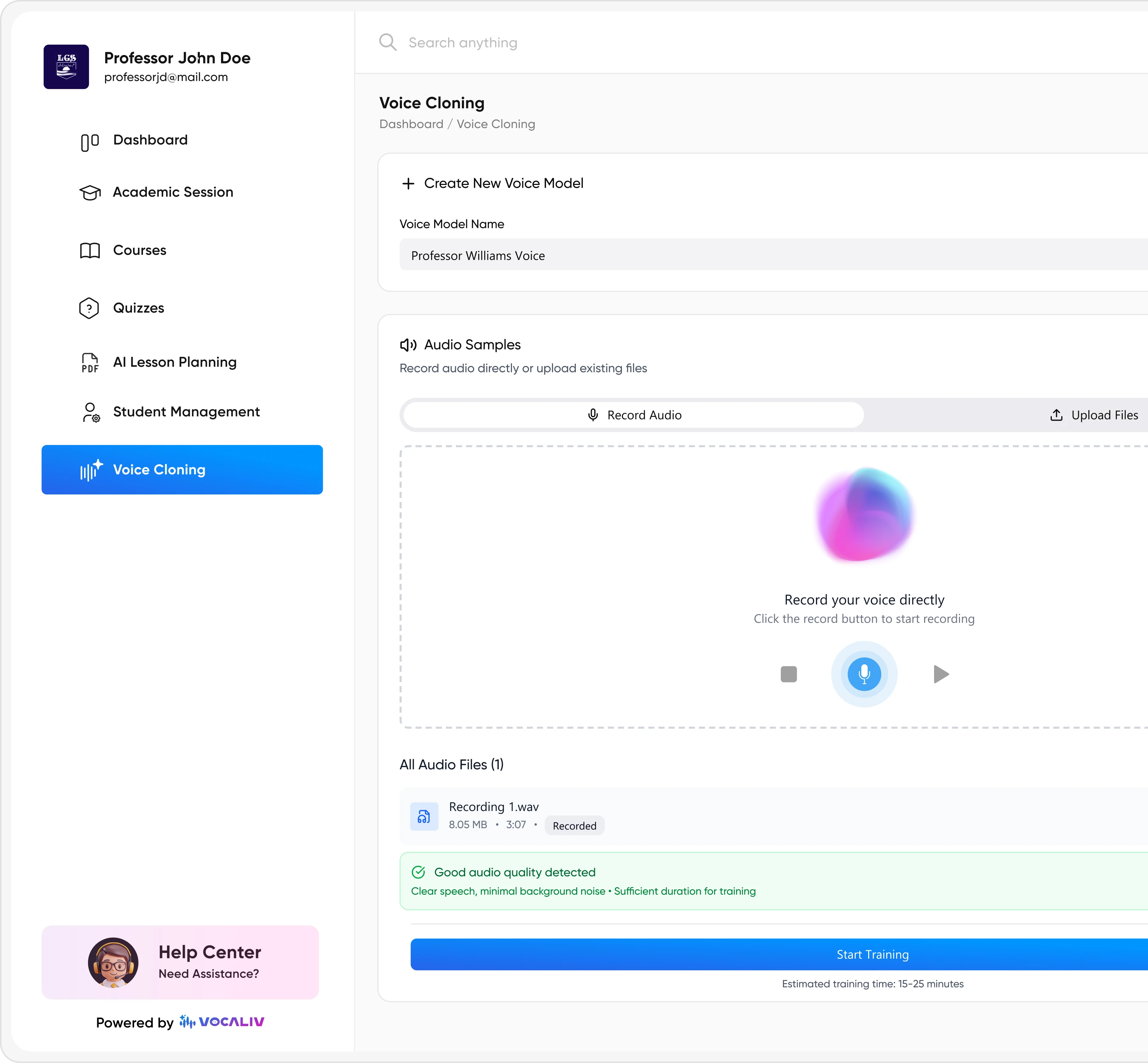
Where appropriate, voice cloning can help deliver AI-assisted course content in a familiar trainer voice.
Start with a structured compliance training template, add your policies and procedures, and turn it into a course your teams can actually use.